Neural networks, by hand
Build a network.
Watch it learn.
Design, train, and export real neural networks by connecting blocks on a canvas. No code required — but real code comes out.
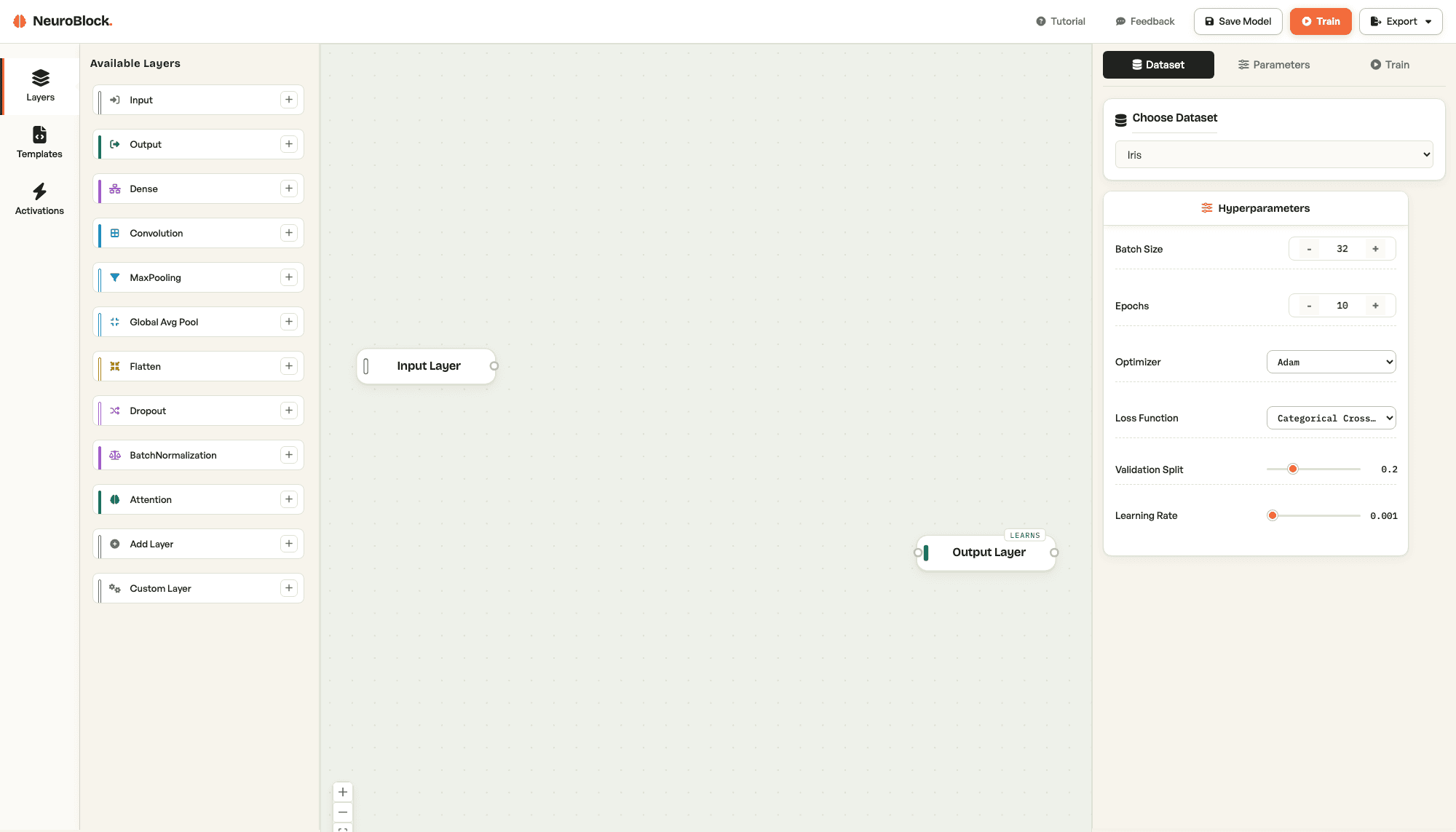
Color that teaches
Every block carries a rule you can see: a filled rail means the layer learns — it has trainable parameters. A hollow rail only transforms its input. Count the filled blocks and you know where your parameters live. The palette is colorblind-validated, so the rule holds for everyone in the room.
Four steps, no setup
Pick a dataset
MNIST, CIFAR-10, Iris — or upload your own CSV or images.
Connect blocks
Drag layers onto the canvas and wire input to output.
Watch it learn
Loss and accuracy stream in live, epoch by epoch.
Export real code
Python, notebook, Keras, or PyTorch — the network you built.
Made for high school students
NeuroBlock is built for a first encounter with deep learning: serious enough to respect its users, friendly enough to invite play. A whole class shares one server — uploads are isolated per session, nothing to install, and everyone watches their networks train at the same time.
The exit ramp is real code
When a model works, students take it with them — a runnable Python script, a Jupyter notebook, a Keras file, or a PyTorch implementation of the exact network they drew. The canvas is the on-ramp; the export is the point.
Ready when your class is.
One Docker container. One URL. The deployment guide takes fifteen minutes.